Clock-Independent Log Sealing
Ghaf uses logseald to provide clock-independent tamper evidence for system
and audit logs. Every logging-enabled component seals records from its local
journal. The Admin VM validates and signs those component chains.
Log sealing protects integrity. It does not encrypt log content. Logs remain
readable through journalctl and remain available in Grafana.
Architecture
Section titled “Architecture”The host and every logging-enabled virtual machine run a producer. The Admin VM runs a producer for its own journal and the central sealer for all producers.
Host journald --------> Host producer ---------+System VM journald ---> System VM producer ----+-- mTLS --> Admin VM sealerApplication VM journal > Application producer -+ |Admin VM journald ----> Admin VM producer -----+ v Signed chain checkpointThe following sequence shows the initial trust binding and the complete path of one journal block through the current implementation:
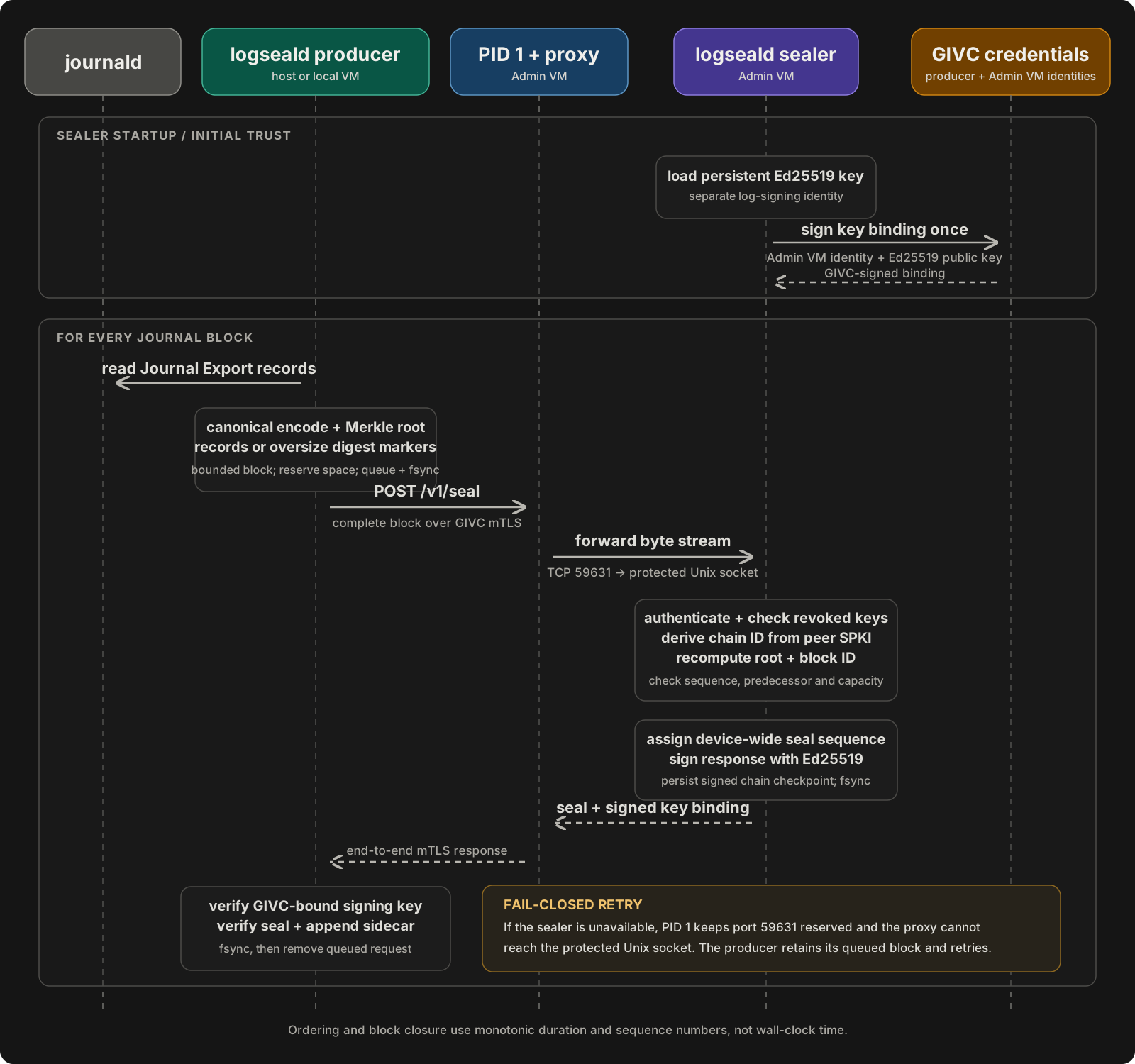
Figure 1. The current logseald sequence. The producer queues a complete block before sending it. The sealer independently validates the full block and persists a compact signed chain checkpoint before returning a verifiable seal.
The current software signing backend uses a persistent Ed25519 key. A TPM or TEE signing backend is not part of this flow.
The application, protocol, verifier, unit tests and Nix package are maintained
in ghaf-logseald. Ghaf pins its source
in flake.lock and builds it with Ghaf’s Nixpkgs. Service hardening, GIVC
credentials, VM placement, persistence and NixOS integration tests remain here.
Changing the source repository does not reset keys or change existing evidence.
Each producer seals records before the normal journal forwarding path aggregates them. Log forwarding and log sealing therefore remain independent. An unavailable remote logging service does not stop local sealing.
Producer
Section titled “Producer”The producer reads the local journal export stream. Journal records can contain binary values and duplicate fields, so the producer uses a binary-safe canonical encoding instead of a text or map representation.
Live records are limited to 256 KiB of canonical data. Larger entries, including
entries whose many individually small fields exceed this budget, are streamed
into an explicit oversize-export-digest-v1 marker. Its
_LOGSEALD_EXPORT_SHA256 and _LOGSEALD_EXPORT_BYTES fields commit to the raw
journal export entry, including binary framing and its terminating blank line.
The marker preserves the journal cursor and boot ID. It does not contain the
original field values; verification of its digest requires the original export
bytes in the same order. Journald and Grafana retain their normal content and
retention policies. Malformed export framing fails closed rather than being
silently skipped.
Blocks close at 256 records, the configured interval, the 1 MiB live block budget, or a boot-ID boundary, whichever comes first.
The producer groups records into blocks. Each block contains:
- Authenticated producer chain identifier
- Component name
- Producer sequence number
- Previous block identifier
- Boot identifier
- First and last journal cursors
- Canonical journal records
- Merkle root of the records
The producer writes the complete block into its durable queue before it advances the recoverable journal cursor. This ordering prevents an acknowledged cursor from referring to a block that was never stored.
Sealer
Section titled “Sealer”The producer sends the complete block to the sealer over mutually authenticated TLS. The sealer does not sign an opaque producer-supplied digest. It decodes the block and recomputes its canonical representation, Merkle root, and block identifier.
The sealer binds the chain to the authenticated GIVC certificate. It then checks the producer sequence and predecessor against the accepted chain head. An accepted block receives a device-wide seal sequence and an Ed25519 signature. The sealer persists a signed checkpoint containing each producer’s current chain head and latest receipt before replying. It does not retain full blocks.
The sealer signs a domain-separated binding between its Ed25519 signing key and the authenticated GIVC transport identity. The producer verifies this binding against the server certificate from the TLS connection before it pins the signing key or accepts a seal. It persists the sealed artifact before deleting the queued request. Retrying the latest request for a chain returns its original seal, even after restart or traffic from other producers. Older requests are rejected, not signed again. Producers submit pending requests in sequence.
Clock-Independent Operation
Section titled “Clock-Independent Operation”Block order, block closure, chaining, and signing do not depend on wall-clock time. The block interval uses process duration rather than realtime. Sequence numbers provide the security order.
The producer reads journals through the systemd-journal group without changing
journald’s startup credentials. VM persistence preserves the journal directory
as 2755 root:systemd-journal. A dedicated oneshot service,
logseald-journal-permissions.service, runs after normal tmpfiles setup and
before the producer. It applies only its private permission rules, repairing
local journal directories to that mode and journal files to 0640 root:systemd-journal.
The directory setgid bit makes replacement files inherit the reader group after
rotation. Only this dedicated permission service receives CAP_FSETID, alongside
the capabilities needed to repair ownership and modes. Existing tmpfiles service
hardening and journald credentials remain unchanged; the producer remains
unprivileged. The setup service reruns when normal tmpfiles setup is restarted.
Repairs do not recursively change other files, grant write access to producers,
or alter signing-key permissions.
Logseald uses the static-cert TLS time policy by default. This policy verifies
the certificate authority, peer name, signatures, and key usage at a time within
the certificate chain validity interval. It does not trust the device clock and
does not enforce certificate expiration. An offline public-key denylist provides
explicit revocation; deploying and updating that list is an administrative
responsibility. There is no automatic CRL or OCSP retrieval.
If the Admin VM is unavailable, producers continue to create chained blocks in their durable queues. At the configured queue limit, a producer stops consuming new journal entries and retries the oldest block. Journald retains records that have not reached the producer queue, subject to the configured journal retention limits.
Identity and Key Separation
Section titled “Identity and Key Separation”Logseald reuses the GIVC public key infrastructure for transport authentication:
/etc/givc/ca-cert.pem/etc/givc/cert.pem/etc/givc/key.pemSystemd passes these files to each unprivileged logseald service as private credentials. The SHA-256 fingerprint of the authenticated certificate public key identifies the producer chain.
Private systemd credential copies do not make the original GIVC key exclusive to logseald. In GUI and application VMs, GIVC also exposes this key to ordinary users for legitimate clients. Those users can therefore impersonate the producer, submit fabricated records or advance its chain ahead of the real producer. This configuration authenticates a VM key holder, not uniquely the journal-reading service. Firewall rules and the separate Ed25519 signing key do not close that boundary. Do not treat seals from these VMs as protection against a compromised local user. Root-only, separately provisioned producer identities are required for that stronger guarantee; they are not provisioned by this module.
The GIVC CA and the exact admin-vm certificate identity are the initial root
of trust. The GIVC key authenticates the network endpoint and certifies the
separate Ed25519 log-signing key once per sealer start. It does not sign each log
block. The sealer stores the Ed25519 key at:
/var/lib/logseald/sealer/sealer.keySeparating these roles prevents a log-signing operation from becoming a general GIVC identity operation.
Network Boundary
Section titled “Network Boundary”The sealer process does not own the TCP port. PID 1 continuously owns port
59631 on the Admin VM’s internal GIVC address and activates an unprivileged
systemd socket proxy. The proxy forwards the byte stream to a protected Unix
socket owned by the sealer. If the sealer stops or crashes, the TCP port remains
reserved, proxy connections fail closed, and producers retain blocks in their
durable queues.
The sealer runs as user logseald-sealer with process group logseald-proxy,
so newly created sockets are accessible to the proxy after every restart.
The runtime directory uses mode 0750 and the socket 0660; setgid directory
inheritance is not required. The sealer state directory remains owner-only
(0700) and its signing key remains 0600, denying the proxy access to them.
The Ghaf firewall removes this port from the generic allow-list and admits new connections only from the configured internal Ghaf node addresses. This source filter limits exposure but is not producer authentication: every request must still complete mTLS and the sealer binds the block chain to the authenticated certificate public key.
Configuration
Section titled “Configuration”Logseald is enabled by default when global logging is enabled. Disable it across the host and all virtual machines with:
ghaf.global-config.logging.logseald.enable = false;Disabling the service preserves producer and sealer state. It does not disable journald, Fail2Ban, journal forwarding, or Grafana.
The central sealer listens on TCP port 59631. Configure a different port with:
ghaf.global-config.logging.logseald.port = 59631;The feature requires global logging, GIVC, and GIVC TLS. The component-level
module exposes these settings under ghaf.logging.logseald:
| Option | Default | Purpose |
|---|---|---|
producer.blockRecords |
256 |
Maximum records in one block |
producer.blockIntervalSeconds |
5 |
Maximum duration of an in-memory block |
producer.maxPendingBlocks |
64 |
Durable blocks retained while the sealer is unavailable |
producer.retryIntervalSeconds |
2 |
Delay between delivery attempts |
endpoint.port |
59631 |
Sealer TCP port |
endpoint.serverName |
admin-vm |
Expected GIVC certificate identity |
tls.timePolicy |
static-cert |
Certificate time validation policy |
tls.revokedPeerKeys |
[] |
Denied peer leaf SPKI identities |
producer.maxStateBytes |
268435456 (256 MiB) |
Queue and sealed evidence byte budget |
producer.maxStateEntries |
100000 |
Total producer evidence entry limit |
producer.windowEntries |
20000 |
Maximum retained sealed blocks, shortened by byte pressure |
sealer.maxStateBytes |
1073741824 (1 GiB) |
Compact checkpoint budget, including atomic replacement |
sealer.maxStateEntries |
100000 |
Identity limit, additionally capped at 256 |
sealer.maxChainBytes |
134217728 (128 MiB) |
Legacy migration per-producer byte limit |
sealer.maxChainEntries |
20000 |
Legacy migration per-producer entry limit |
Offline Revocation
Section titled “Offline Revocation”Add compromised leaf public-key identities to
ghaf.org.telemetry.logging.logseald.revokedPeerKeys. Each element has the form
spki-sha256: followed by 64 lowercase hexadecimal characters. Obtain a leaf ID
from its certificate (this reads no private key):
openssl x509 -in /etc/givc/cert.pem -pubkey -noout | openssl pkey -pubin -outform DER | sha256sumPrefix the resulting digest with spki-sha256:. Deploy the list to the host and
all participating VMs and restart their producer/sealer services. A host-only
configuration switch does not update already running guests. Policy is loaded
at service startup; existing connections must be terminated by restarting the
services. Both TLS modes enforce the list on new and resumed handshakes. Renewing
a certificate using a denied key cannot bypass the list. To distrust a CA,
replace the CA trust bundle; the denylist targets leaf keys, not CAs.
Changing a producer public key changes its chain identity. Ghaf enables
--reset-on-credential-change: a producer discards its previous sealing state
when its public key or CA bundle changes. The sealer discards its checkpoint,
chain heads and signing key when the CA bundle changes. Each reset is logged.
This allows GIVC credential regeneration on reboot to start fresh chains without
changing GIVC’s credential lifecycle.
The first start with this policy also clears legacy state without a
credential-epoch marker. Old sealed evidence, pending blocks and the journal
cursor are discarded; retained journal records are read again for the new
chain. Deploy to all producers and the sealer and reboot together. There is no
evidence-continuity or replay-history guarantee between credential epochs.
Service restarts, leaf renewals using the same key, and reboots with unchanged
credentials preserve the current chain. The CA bundle is fingerprinted as file
bytes, so editing or replacing it also starts a new epoch.
Capacity and Memory
Section titled “Capacity and Memory”The sealer admits one request body at a time, with a 2 MiB HTTP body limit and a 1 MiB decoded live block limit. The socket proxy permits at most 16 connections. Producer queues and sealed history retain compact metadata in memory; pending bodies are read from disk on demand. Startup verifies evidence files one at a time rather than loading the full ledger into memory.
Systemd applies MemoryHigh/MemoryMax of 192/256 MiB to each producer and
256/384 MiB to the sealer, with no swap allowance. These are pressure/hard limits,
not reserved memory or measured normal consumption. The producer limit also
covers its journalctl subprocess. Go GC targets are 128 MiB and 192 MiB;
those are soft targets, not replacements for systemd containment. An exhausted
memory limit can stop sealing in that service; it does not guarantee availability
under sustained attack or sufficient memory for every VM configuration.
Sliding Evidence Window
Section titled “Sliding Evidence Window”Each producer retains at most 20000 sealed blocks within the 256 MiB evidence budget, including its pending queue. At one block every five seconds, this is about 28 hours. It is not a one-day guarantee: busy producers fill blocks faster and byte pressure can shorten the window. Sequence numbers and bytes control expiry, so wall-clock jumps and Internet connectivity do not change it.
Within a credential epoch, only acknowledged blocks expire. The producer durably writes the last expired block’s signed receipt as a boundary before deleting the block. It keeps at least one sealed block to recover the journal cursor. Pending blocks are never expired, and space is reserved for their returned seals. If pending data or an individual block cannot fit, ingestion still stops with exit status 75. Journal retention can then remove records that have not been consumed.
The sealer retains one current signed head and latest retry receipt per identity, not a full-block ledger. Its signed checkpoint is capped at 1 MiB and 256 identities. Atomic replacement temporarily needs a second checkpoint copy. The byte budget must cover both. Old identities are not automatically forgotten, since forgetting one would permit replay of its old chain. At the identity cap, existing chains continue but new identities are rejected. A CA-bundle change starts an empty checkpoint for the new credential epoch.
On upgrade, the sealer verifies the legacy ledger, commits its compact checkpoint and removes the old full-block entries. Producers expire acknowledged history to their configured window. This is a one-way storage migration. Back up evidence before upgrading if older history is needed, and do not run the old binary against migrated state. Keys, counters and retained state survive reboots with unchanged credentials.
Set producer.windowEntries = 0 to disable further producer expiry. Already
expired evidence is not recoverable. Verification checks retained evidence and
reports the expired prefix explicitly. Sealer verification checks its checkpoint
and current heads, not historical block contents. Neither verifies that Grafana
has archived records or receipts, and forwarding does not trigger deletion.
Keep additional space for filesystem overhead, producer boundary/pin/lock metadata,
temporary atomic writes, journals and other services. Writers are exclusive,
and verification uses a shared state lock to avoid racing cleanup. Verification
does not prune or migrate evidence. Limit overrides remain available through
--max-state-bytes, --max-state-entries and legacy sealer --max-chain-*.
The v1 archival format limits remain unchanged. Before upgrading an existing
installation, drain any pending blocks larger than the new 1 MiB live limit;
they cannot be split without changing their committed identity. Historical
large artifacts can need more memory during verification than the service caps.
Every service startup re-verifies retained history: offline verification alone
does not avoid that requirement. Before upgrading such a store, measure its
startup memory on a suitably sized maintenance system and set
ghaf.logging.logseald.producer.memoryMaxMiB or
ghaf.logging.logseald.sealer.memoryMaxMiB above that peak with headroom. These
default to 256 and 384 respectively. Provision the VM with sufficient RAM for
the increased cap and its other services; do not increase caps blindly on a
1 GiB Admin VM. Retain the larger cap while those artifacts remain in active
history. Existing stores
above the configured capacity fail closed until capacity is provisioned.
Services and State
Section titled “Services and State”| Component | Service | State directory |
|---|---|---|
| Host producer | logseald-producer.service |
/persist/common/logseald/producer |
| VM producer | logseald-producer.service |
/var/lib/logseald/producer |
| Admin VM sealer | logseald-sealer.service |
/var/lib/logseald/sealer |
| Admin VM listener | logseald-sealer.socket, logseald-sealer-proxy.service |
/run/logseald-sealer/sealer.sock |
Producer state contains queued requests, sealed artifacts, and the pinned sealer public key, plus a signed boundary after expiry. The central state contains the Ed25519 signing key and compact signed checkpoint. VM state is persisted through the Storage VM when storage persistence is enabled, including the Media VM’s logseald state even though its application/user state remains ephemeral.
Verify a Deployment
Section titled “Verify a Deployment”Host Producer
Section titled “Host Producer”Check the service:
sudo systemctl is-active logseald-producer.servicesudo systemctl status logseald-producer.service --no-pagersudo journalctl -b -u logseald-producer.service -n 50 --no-pager -lVerify the host chain and signatures:
sudo logseald verify-producer \ --state-dir /persist/common/logseald/producer \ --cert /etc/givc/cert.pem \ --source "$(hostname)"Admin VM
Section titled “Admin VM”In the Admin VM, check the services, socket, and listener:
sudo systemctl is-active logseald-producer.service logseald-sealer.service logseald-sealer.socketsudo ss -ltnp | grep -F ':59631'Verify the Admin VM producer and compact sealer checkpoint:
sudo logseald verify-producer \  --state-dir /var/lib/logseald/producer \  --cert /etc/givc/cert.pem \  --source "$(hostname)"
sudo logseald verify-sealer --state-dir /var/lib/logseald/sealer
Successful verification reports PASS and the number of sealed or queued
blocks. A queued block count of zero means the producer has received seals for
all durable requests.
Pipeline Marker
Section titled “Pipeline Marker”Create a unique journal record on the host and wait for the default block interval:
logseal_state=/persist/common/logseald/producerbefore=$(sudo find "$logseal_state/sealed" -type f -name '*.json' | wc -l)
marker="LOGSEAL_PIPELINE_TEST_$(date +%s)"systemd-cat --identifier=logseald-test echo "$marker"journalctl -b -t logseald-test -o cat --no-pager | grep -F -- "$marker"
sleep 12after=$(sudo find "$logseal_state/sealed" -type f -name '*.json' | wc -l)
test "$after" -gt "$before" && echo "PASS: new block sealed"
Run verify-producer and verify-sealer again after this test. Other system
activity can create additional blocks while the commands run.
Troubleshooting
Section titled “Troubleshooting”Producer Queues Locally
Section titled “Producer Queues Locally”This message means the producer could not reach the sealer:
seal submission unavailable; queueing locallyCheck the sealer service, sealer socket and proxy units, TCP listener, Admin VM
connectivity, and GIVC credentials. A later seal submission recovered message
confirms that delivery resumed. Persistent queued blocks remain under the
producer queue directory.
Verification Fails
Section titled “Verification Fails”Treat a verification failure as an integrity or state-continuity failure. Do not delete or rewrite the queue, sealed artifacts, pinned key, signing key, or ledger. Preserve the complete state directories before investigating the first reported sequence or signature error.
Certificate Changes
Section titled “Certificate Changes”The producer pins the first signing key whose binding verifies under the authenticated Admin VM GIVC identity. Replacing the Admin VM certificate does not replace the Ed25519 sealer key when the CA bundle is unchanged; the sealer creates a new binding for the same signing key. A CA-bundle change resets both the sealer’s signing key and the producers’ pins under the credential-epoch policy above. Resetting only the sealer while producers retain their pins causes them to reject its seals.
Security Properties
Section titled “Security Properties”Logseald detects these changes within retained evidence:
- Modified canonical records
- Incorrect Merkle roots
- Inserted or missing non-trailing blocks
- Reordered blocks
- Incorrect predecessors
- Producer-chain forks
- Changed sealer signatures or public keys
Mutual TLS prevents an unauthenticated node from claiming another GIVC chain identity. Durable state transitions and idempotent retries preserve one accepted history across service crashes and network retries.
Limitations
Section titled “Limitations”Logseald does not provide these properties:
- Log confidentiality or encryption at rest
- Proof that applications logged truthful or complete information
- Prevention of log-production denial of service
- Hardware-backed protection for the Ed25519 signing key
- Detection when the software key and complete trailing ledger state are rolled back together
- Automatic certificate expiration under
static-cert, or automatic online revocation - Isolation from ordinary users who share a VM’s GIVC private key
- Protection after compromise of the Admin VM GIVC private key or CA
- Port reservation if the socket unit or PID 1 is stopped by an administrator
- Verification or recovery of expired contents without an external archive
- Guaranteed minimum retention time or detection of all prefix truncations
- Global Merkle inclusion or consistency proofs for the central ledger
Producers retain canonical records or explicit oversized-entry digest markers inside the bounded window. The sealer retains metadata. Protect both as sensitive state. A signed boundary commits to earlier history but does not archive it or prove that a longer prefix was not removed. An independently retained recent checkpoint/reference is needed to detect rollback and some truncations.
Auditing
Section titled “Auditing”The standard laptop and Orin profiles enable auditing independently of logseald. Debug and release global profiles enable it for guests, including app VMs and the IDS VM. Minimal profiles retain their audit-disabled default. Disabling logseald does not disable auditing in standard builds. Platform overrides can still change this policy.